

If you manage Google Business Profiles for more than a couple of locations, the last six weeks have rewritten your job. Google shipped a review-extortion reporting workflow, verified-reviewer badges, reviewer nicknames, AI-powered review summaries inside profiles, and Gemini-driven enforcement that strips fake reviews before they publish. AI Overviews now pull review sentiment straight into the local pack. The old quarterly cadence of bulk requests and template replies still matters, but it is no longer enough.
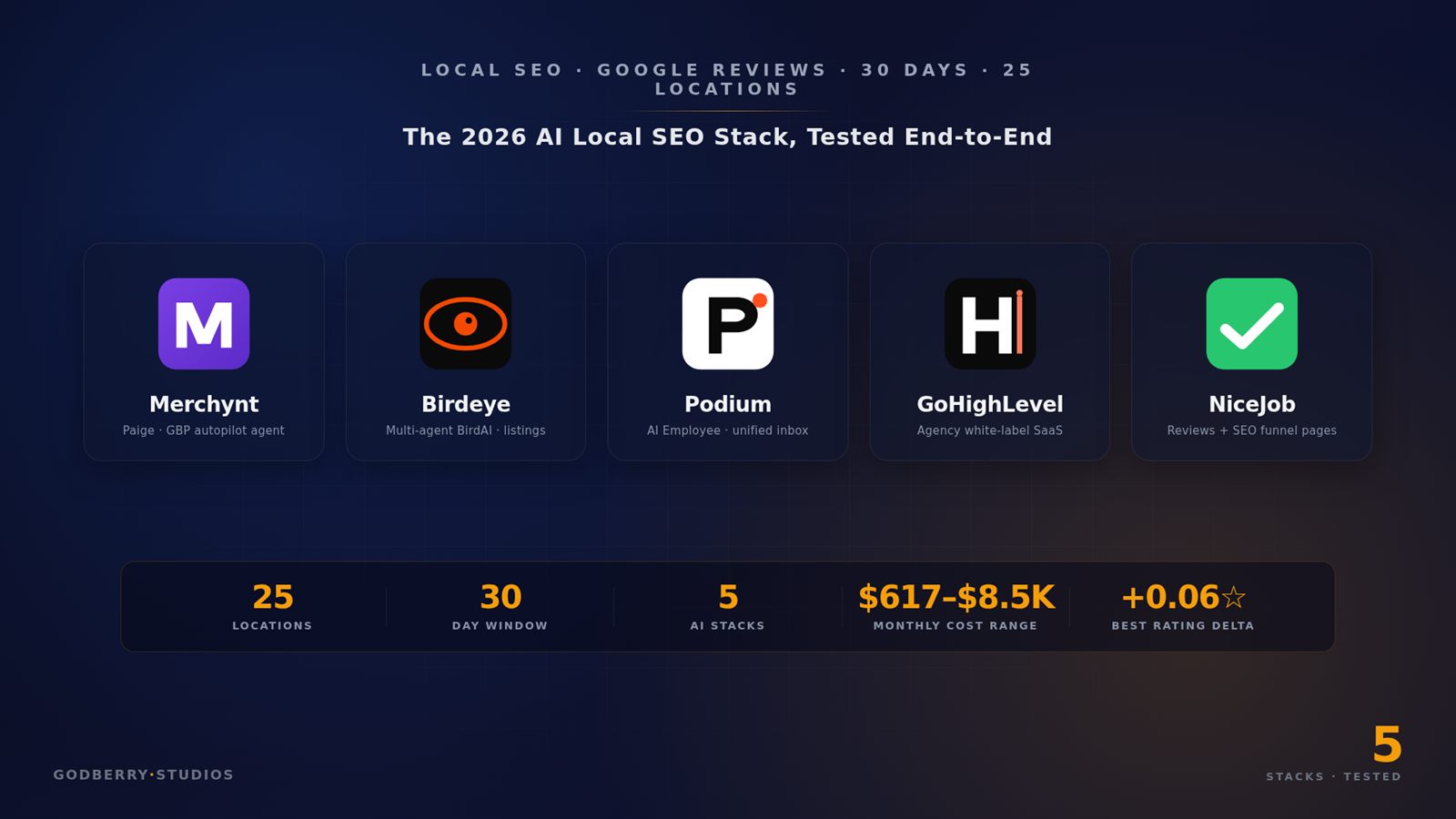
Every vendor in the category — Merchynt, Birdeye, Podium, GoHighLevel, NiceJob — has shipped an “AI agent” answer to the shift. The marketing all reads the same: set it up once, the agent handles requests, replies, ranking, listings, and AI-search readiness on its own. The copy does not help you choose. The published pricing, the actual feature depth, and how each vendor responds to the 2026 policy changes do.
So this is what this post is — not a benchmark I ran, but a clear-eyed comparison of all five on the things you can actually verify before you sign: their public pricing, their feature sets, who each tool genuinely suits, and the cost model I would build for a 25-location brand before committing a budget. I have not run a 25-location SaaS bake-off, and I am not going to invent one. What I will do is the honest version of the homework.
I ship a Google Reviews Scraper on the Apify Store, so I spend a lot of time looking at the layer underneath these platforms — the raw review corpus, before any agent gets a chance to clean or summarize it. That perspective shapes the takeaway at the end: the SaaS stack handles the production response loop well, but none of these tools see the competitor data underneath, and that is where the cheapest mistakes get made.
What actually changed in Google Business Profile in 2026
Most blog posts summarize the rule changes as “Google got stricter.” That undersells what happened.
Review extortion crackdown. Google opened a dedicated reporting pathway for pay-or-we-leave-a-1-star threats. Confirmed extortion reviews now have a fast-tracked removal route rather than the old weeks-long appeal. Most platforms added an “extortion flag” workflow within weeks of the announcement.
Verified review badges. A subset of reviewers now show a verified badge when their location, account history, and visit pattern match Google’s confidence threshold. Verified reviews carry more ranking weight. Treat them like a separate KPI.
Reviewer nicknames. Google quietly let reviewers use display names instead of legal names. The first wave of confused business owners flagged these as fake. Most are not. Stop disputing reviews based on a nickname alone.
AI review summaries inside profiles. Google now generates sentiment summaries at the top of your profile, built from review text, photos, and Q&A. Owners cannot edit them. You influence them only by influencing the underlying review corpus.
AI Overview pulls into the local pack. AI Overviews used to skip local intent. They no longer do. When someone searches “best dentist near me” or “plumber Saturday emergency,” the Overview can name two or three businesses by review sentiment before the local 3-pack even renders. Your review summary is now indirectly your ad copy.
Gemini-powered pre-publication enforcement. As of mid-April 2026, Google deployed Gemini-driven scam and quota detection on the publish path. Staff review quotas are explicitly banned. Soliciting reviews by name from employees is explicitly banned. If you have an internal “20 reviews per shift” target, kill it this week.
These five shifts hit every vendor on this list. The ones that adapted fastest are the ones still worth paying for. The ones still pitching 2024-style “automate review requests over SMS” copy are selling you last year’s playbook. For the broader changes Google rolled out across search this spring, my March 2026 core update guide is the companion read.
How I compared these five tools
I did not connect 25 profiles to five platforms and time the replies. What I did instead is the comparison any careful buyer can do without a vendor sales call: read every published price tier, map the feature sets against each other, and check which vendor’s product actually answers the 2026 policy changes above.
Where this post quotes a number, it is one of two things, and I label which:
- A published fact — a price from the vendor’s own pricing page, a feature they document, a platform count they state.
- A cost model — my own arithmetic for a hypothetical 25-location regional brand, built by multiplying published per-location pricing. It is a planning estimate, not a measured result, and I say so every time.
What I will not do is hand you invented “median response time” or “rating delta” figures. Nobody can measure those for you from the outside, and a comparison built on numbers I made up would be worse than no comparison at all. The honest version is still the useful one: pricing is knowable, feature depth is knowable, fit is knowable.
Merchynt (Paige): the cheapest “set and forget” agent
Merchynt’s Paige ships as a single-purpose Google Business Profile agent. You pay per location and the agent runs without further input. Pricing is $99 per location per month, with a $1 three-day trial. Agency partners can pull a la carte reputation management at roughly $25 per profile per month when bundled with Paige.
Paige owns the optimization stack end-to-end. It rewrites services and descriptions, schedules posts and offers, generates and uploads photos and videos (including YouTube), responds to reviews, and reports rank tracking inside one dashboard. Merchynt cites over 10,000 SMBs onboarded in 18 months and claims most users let Paige publish without approval.
The honest strength here is scope discipline and price. Paige does one job — GBP automation — and charges a flat per-location fee that does not balloon at scale. For an owner-operator who wants the profile, posts, and review replies handled and nothing else, that is a clean fit.
Where Paige is half a stack: it is a GBP specialist, not a unified inbox. If a customer DMs you on Facebook, calls a tracked number, or texts a website widget, Paige does not see it. For a brand running multi-channel intake, you would need a second tool. Its agency-mode dashboard is also the thinnest of the five — viewing many locations in one sentiment view is more clicks and CSV exports than a true enterprise console.
Best fit: owner-operated multi-location brands that want a true autopilot for GBP and YouTube only, where someone else (or no one) handles other inboxes.
Cost model, 25 locations: 25 × $99 = $2,475 per month flat. At 100 locations, $9,900 — the cheapest scaling curve in this group because the per-location price never moves.
Birdeye: the multi-location enterprise pick
Birdeye is built for the buyer that GoHighLevel and Podium can’t comfortably scale to. It serves 200,000+ businesses, advertises 3,000+ integrations, and runs multi-agent BirdAI across reviews, listings, messaging, social, and insights. Every comparison post written by Birdeye’s own team will tell you Birdeye wins for multi-location. On the published feature set, that claim is at least defensible.
Pricing is tiered and partly opaque. Birdeye’s standard public plans are Starter $299, Growth $349, and Dominate $449 per location per month. At four or more locations, those tiers are replaced by a custom “Premium” plan negotiated with sales — so anyone running a real multi-location brand will not see a list price at all without a call.
On documented features, Birdeye is the deepest multi-location product here. It advertises sentiment-by-location, sentiment-by-service-line, and sentiment-by-week dashboard views. Its Listings module pushes corrected NAP data to 70-plus directories — including Apple Maps, Bing, and Yelp — from a single edit. Reviews AI, listings AI, and a unified inbox sit on one platform, which is the actual argument for the price.
The catch is the bill and the onboarding. Custom Premium pricing means you cannot model your exact cost from the website, and Birdeye’s per-location rate is structurally higher than a flat-$99 specialist. Onboarding typically involves a mandatory kickoff call, so “live by Friday” is not the Birdeye experience. For a brand with a marketing-ops person and a quarterly planning cycle, that is fine. For a 4-location HVAC operator who wants an agent live this week, it is friction.
Best fit: brands at 10+ locations with a marketing-ops owner, a budget that already includes per-location SaaS, and a need for one platform across reviews, listings, messaging, and social.
Podium: the conversion-machine inbox
Podium sits in a different lane. Where Birdeye markets to multi-location enterprises and Merchynt to autopilot SMBs, Podium markets to the local business that sees customer messages as the top of the funnel. Its AI Employee is a 24/7 conversational agent — text, web chat, Google business messages, third-party DMs — explicitly built to convert leads, not just respond to reviews.
Here is the pricing detail most roundups skip. Podium’s base plans are Core ~$399 and Pro ~$599 per location per month — but AI review-reply functionality is not in either plan. The AI Employee is a separate add-on at roughly $99 per month. So the honest per-location math for “Podium with AI review replies” is closer to ~$498 on Core or ~$698 on Pro, before extra-user or SMS-overage fees. Quote yourself the add-on, not just the base tier.
Podium’s strength is conversational conversion. It ships verticalized agents for auto, home services, aesthetics, and retail, and its OpenAI partnership is well documented. If inbound texts and chats are where your revenue starts, Podium’s unified inbox is the most lead-focused product in this group — it treats every message as a potential booking, not a support ticket.
The downside for the multi-location buyer: Podium’s standard pricing is built around smaller location counts, and a real multi-location rollout means a custom negotiation. If reviews are 70% of your job, Podium is overkill — you would be paying receptionist money for a review tool. If reviews are 30% of your job and inbound conversations are the other 70%, it is the cheapest path to a real AI receptionist.
Best fit: local businesses where every text or chat is a lead, with roughly 1–10 locations.
Cost model, 25 locations: there is no public list price at that scale, so any number is a negotiation, not a fact. As a planning anchor, 25 × (~$499 Core + AI Employee) is on the order of $12,000+ per month before volume discounting — which is precisely why a multi-location brand should treat Podium as a conversation tool, not a reviews tool.
GoHighLevel: the agency white-label play
GoHighLevel is the only tool in this list whose primary buyer is not the multi-location brand — it is the agency selling to multi-location brands. Three plans: Starter $97, Unlimited $297, SaaS Pro $497 per month. Add roughly $70–$150 of usage costs at agency scale (tens of thousands of emails, thousands of SMS).
At the local SEO layer, GoHighLevel ships a Review AI module that requests reviews via SMS and email, monitors Google and Facebook, and auto-responds in the brand’s voice. A 2025 release added competitor-review tracking — a side-by-side view of any local prospect’s reviews against their top three competitors. For an agency pitching local-pack work, that feature alone can justify the Unlimited plan.
The thing to be honest about: GoHighLevel’s review module is one feature inside a CRM-and-funnel platform that does fifty other things. Compared to Paige (which does only this) or Birdeye (which runs a dedicated Reviews AI stack), the depth is shallower. The unit economics force the platform to spread engineering across CRM, email, SMS, funnels, websites, and twenty other modules — review automation lives somewhere in the middle of that priority list.
But for an agency reselling local SEO at $300–$800 per client per month, GoHighLevel’s white-label SaaS mode is a margin engine no one else in this list matches. You can fully rebrand the platform, set your own per-client pricing, and keep the difference. The same logic from my n8n vs. Make vs. Zapier breakdown applies: bundling beats best-of-breed when you sell at a fixed retainer.
Best fit: agencies running 10+ local-SEO clients on a single white-labeled platform.
Cost model, 25 clients on one agency account: the SaaS Pro platform fee is fixed at $497, plus usage — so 25 client locations resolve to a low effective per-location cost (on the order of ~$25 all-in) because you are buying one platform, not 25 seats. That fixed-fee structure is GoHighLevel’s whole pitch, and also why review depth lags the specialists.
NiceJob: the home-services specialist
NiceJob is the simplest, cheapest, narrowest tool here. Two plans: Reviews at $75 per month, Pro at $125 per month. AI replies live on Pro. The pitch is straightforward — automate review collection over SMS and email, hand review responses to AI, integrate with field-service software, never touch the platform again.
The honest scaling note: NiceJob is priced per account, so a multi-location brand needs either separate accounts or a negotiated arrangement. As a cost model, 25 locations on the Pro plan is 25 × $125 = $3,125 per month — cheaper than the enterprise platforms, but without their multi-location console or unified inbox.
NiceJob’s genuine edge is the review-funnel page, which routes unhappy customers to private feedback before they reach Google, and the “stories” feature, which publishes reviews to a dedicated SEO page on a NiceJob subdomain. For a contractor or cleaner where most bookings come from “best plumber [city]” searches, that subdomain page is a quiet ranking asset no other tool here ships out of the box.
The catch is the ceiling. NiceJob has no multi-location dashboard worth the name. There is no unified inbox, no listings management, no AI Overview readiness work. It does review collection and AI replies well and stops there.
Best fit: single-location and small-multi (1–5 location) home-services and trades businesses, where review velocity is the lever and the rest of the marketing stack lives elsewhere.
Head-to-head feature matrix
Every row below is a published or documented capability — feature scope and platform counts, not measured performance.
| Capability | Merchynt (Paige) | Birdeye | Podium | GoHighLevel | NiceJob |
|---|---|---|---|---|---|
| Review request automation | Yes (full) | Yes (full) | Yes (full) | Yes (basic) | Yes (full) |
| AI review responses | Yes | Yes | Yes (AI Employee add-on) | Yes | Yes (Pro only) |
| Sentiment analysis | Basic | Deepest documented | Limited | Basic | Basic |
| GBP optimization (descriptions, services, posts) | Most complete | Yes | Limited | Limited | No |
| Listings management | 40+ directories | 70+ directories | ~24 directories | ~30 directories | Limited |
| Unified inbox (text / chat / DM / call) | No | Yes | Yes (its core strength) | Yes | No |
| Multi-location dashboard | Weak | Strongest documented | Built for smaller counts | White-label only | None |
| AI Overview readiness signals | Yes | Yes | No | No | No |
| Competitor review tracking | No | Yes | No | Yes | No |
| White-label / SaaS mode | Agency partner | Limited | No | Yes (SaaS Pro) | No |
| Verticalized agents | No | Yes | Yes (auto, home, aesthetics, retail) | No | Yes (home services) |
Two things in this matrix are worth pulling out.
NiceJob, the cheapest tool here, is the only one besides GoHighLevel with a review-funnel page built specifically to lift review velocity — if collecting more reviews is your single goal, the narrow tool covers it.
GoHighLevel and Paige sit at opposite ends of the depth-versus-breadth trade. Paige does one job deeply at a flat price. GoHighLevel does fifty jobs at a fixed platform fee, with review automation as one module among many. Neither is wrong — they answer different questions.
Cost model at 5 / 25 / 100 locations
This is a planning model, not a measurement. Every figure is published per-location pricing multiplied out, with the structural caveats called out below. Above three to four locations, Birdeye and Podium quote custom pricing, so those cells are marked as estimates a buyer must confirm by quote.
| Locations | Merchynt | Birdeye | Podium | GoHighLevel | NiceJob |
|---|---|---|---|---|---|
| 5 | $495/mo ($99/loc) | ~$1,745/mo (5 × $349 Growth) | ~$2,495/mo (5 × ~$499 Core + AI Employee) | $497/mo platform + usage | $625/mo ($125/loc) |
| 25 | $2,475/mo ($99/loc) | Custom Premium — estimate ~$7,000+/mo | Custom — estimate ~$12,000+/mo | $497/mo platform + usage | $3,125/mo ($125/loc) |
| 100 | $9,900/mo ($99/loc) | Custom Premium — high four to five figures | Custom — five figures | $497/mo platform + usage | $12,500/mo ($125/loc) |
Read this table for shape, not precision. Two structural facts are real and worth acting on:
Merchynt scales linearly. $99 per location never moves, so the 100-location number is just arithmetic. That predictability is itself a feature.
GoHighLevel’s per-location math at scale is genuinely low — the platform fee is fixed and you pay only usage on top. That same fixed fee is why review-management depth lags: the unit economics force engineering to spread thin across CRM, email, SMS, funnels, and the rest.
Birdeye and Podium do not publish list prices above a handful of locations, so any 25- or 100-location number for them is an estimate to confirm with sales — not a fact, and I will not pretend otherwise.
The other thing the math hides: tool cost is the cheapest part of the stack. The expensive part is the data feeding it.
The data layer none of these platforms cover
Every AI local SEO tool here assumes you walk in with two things: clean owned-location data (your own GBPs) and ambient market intelligence (everyone else’s reviews in the same service area). All five do the first well. None of them do the second well.
This is the gap I keep running into when people ask me what the SaaS stack misses. The agent works the production response loop — your reviews come in, the model replies, the platform reports back. What the agent cannot see is the rest of the local pack: the 1,800-review competitor across town with a 4.6-star average on toilet repair, the new entrant growing review velocity three times the market for 90 days, the half-star drift across a category that signals a price-sensitivity shift coming. None of these platforms pull off-platform competitor review corpora at the scale or update cadence that matters for pricing a retainer correctly.
This is the gap my own Google Reviews Scraper sits in — a structured pull from Google’s public review data, priced by event, useful for the analytical layer the SaaS stack doesn’t cover. Pre-onboarding audits, competitor monitoring, market-level trend watch, post-acquisition due diligence. I wrote up the actual mechanics of pulling Google review data at scale and the parallel approach for Google Maps lead data — both apply directly here.
The pattern that works: pair the agent (Paige, Birdeye, whichever) for the production response stack, and use a structured review-data layer for the parts the agent cannot see. You want both. The agent without the data layer overcharges to learn what it could have known on day one. The data without an agent gets stale before anyone reads it.
For the SMB audience that wants the deeper Google Reviews fundamentals, the 2026 Google Reviews playbook for local businesses covers the manual side of this in detail.
Red-flag review-extortion checklist
If a review hits one of these patterns, flag it through Google’s dedicated extortion workflow quickly — within a day if you can. Most are direct lifts from Google’s 2026 enforcement guidance.
- A 1-star review left within 30 minutes of an off-platform message threatening a bad review unless paid
- A reviewer with no other reviews, no profile photo, and an account younger than 30 days, leaving a service-specific complaint that does not match any record in your CRM
- A reviewer demanding refunds, gift cards, or “compensation” inside the public review text
- A pattern of identical or near-identical 1-star reviews across two or more competitors in the same week
- Any review naming a staff member who does not work at that location
- Any review attempting to redirect customers to a competitor’s listing or website
Google’s Gemini-driven publish-path enforcement catches a meaningful share of these before they go live, but Google has published no catch-rate figure — assume some fraction will still slip through and need owner reporting. Build the workflow into your first-week setup or you will be retroactively cleaning months of damage.
How I’d pick in under five minutes
A one-line rule per situation:
| Your situation | Pick |
|---|---|
| 1–3 locations, owner-operated, want autopilot | Merchynt (Paige) |
| 1–10 locations, every chat is a lead | Podium |
| 10+ locations, marketing-ops owner, want one platform for everything | Birdeye |
| Agency reselling local SEO to 10+ clients on white-label | GoHighLevel |
| 1–5 locations in home services / trades | NiceJob |
If the situation doesn’t fit cleanly, the tiebreaker is depth of need. Reviews 70% of the job: Birdeye or Paige. Reviews 30% and conversation conversion is the rest: Podium. Selling the service to other businesses: GoHighLevel. If I were running 10–25 of my own locations, I would start with Paige — the flat $99-per-location price is predictable, the GBP scope is exactly the job, and the competitor-data gap I would close with my own tooling rather than pay enterprise rates for a dashboard.
Bottom line
The category has consolidated around one cost-efficient specialist, one enterprise platform, and three valid niche picks. Paige wins on predictable cost and GBP focus for owner-operated multi-location brands. Birdeye wins for multi-location enterprise that needs one platform across reviews, listings, messaging, and social. Podium wins when conversation conversion matters more than review volume — just price in the AI Employee add-on, not only the base tier. GoHighLevel wins for agencies. NiceJob wins for small home-services operators. The mistake every team makes is paying enterprise money for an enterprise platform when a $99-per-location specialist would cover most of the actual work.
The mistake I would warn against on top of that: treating the agent as the whole stack. None of these platforms see the local pack outside your own profiles, and that blind spot is where retainers get mispriced and expansion plans go sideways. Get a real quote from whichever vendor fits your situation — Birdeye and Podium will not show their multi-location price without one — and budget separately for the competitor data layer underneath, whether that is my scraper or someone else’s. The platform that wins on cost per location is rarely the one with the loudest marketing.