
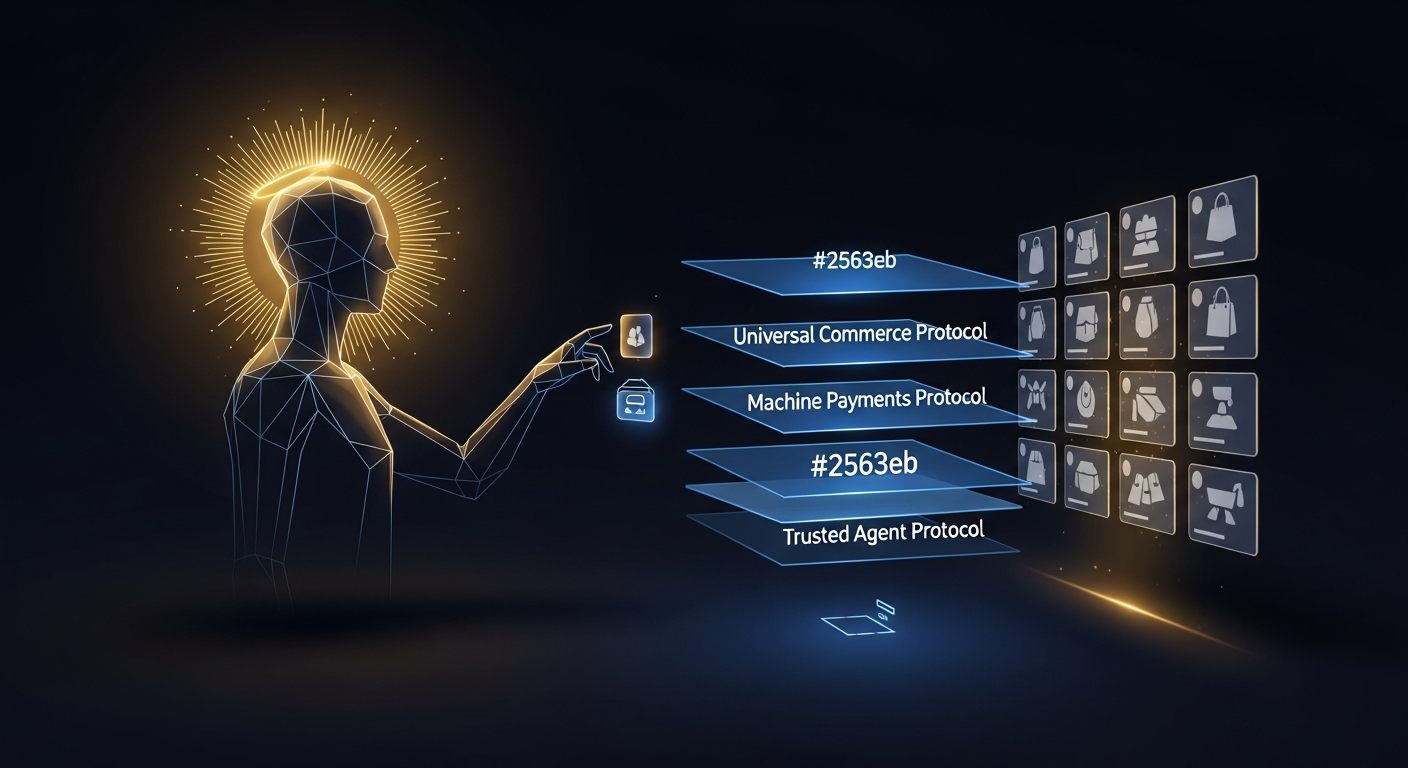

Agentic commerce is the shift where AI assistants — ChatGPT, Gemini, Copilot, Perplexity — discover, compare, and buy on behalf of the shopper. eMarketer projects it will move roughly $20.6 billion of US retail spend in 2026, nearly 4× the 2025 figure. Four protocols now stitch it together: ACP, UCP, MPP, and the Trusted Agent Protocol. Shopify flipped every eligible US store into ChatGPT by default on March 24, 2026. Visa announced Intelligent Commerce Connect on April 8, 2026. And in late March 2026, OpenAI pulled its own Instant Checkout after only about twelve merchants integrated. If you sell anything online, the next month decides whether an agent will even show your product to the shopper who asked for it.
I run paid scrapers on the Apify Store, so I watch this space partly as a developer who gets paid by agents (via pay-per-event metering and, increasingly, x402-style rails) and partly as someone who has to make sure my own product listings get surfaced. The merchant playbook below is what I would do if I owned a storefront today.
What Actually Happened in Q1 2026
Four protocols and four platforms moved inside a fifteen-week window, and they depend on each other. The real timeline, in order:
- January 8, 2026 — Microsoft launches Copilot Checkout with PayPal, Shopify, and Stripe, plus retail partners Urban Outfitters, Anthropologie, Ashley Furniture, and Etsy. Buyers complete purchases inside the chatbot; the merchant stays merchant of record.
- January 11, 2026 — Google announces the Universal Commerce Protocol (UCP) at NRF. Founding partners: Shopify, Etsy, Wayfair, Target, Walmart. UCP goes live in Merchant Center the same month.
- March 24, 2026 — OpenAI removes Instant Checkout from ChatGPT. About six months of live data showed weak adoption — only 8% of US adult ChatGPT users tried it in its first month, and usage stayed low; only about twelve Shopify merchants had integrated. OpenAI pivots: shoppers evaluate in ChatGPT, then check out on the merchant’s own storefront.
- March 18, 2026 — Stripe and Tempo publish the Machine Payments Protocol (MPP). Over fifty services adopt it at launch, including OpenAI, Anthropic, Google Gemini, and Dune. MPP handles stablecoins, cards, and Bitcoin Lightning through a single endpoint.
- March 24, 2026 — Shopify activates Agentic Storefronts by default for every eligible US store. Overnight, about 5.6 million merchants become discoverable inside ChatGPT, Microsoft Copilot, Google AI Mode, and the Gemini app.
- April 8, 2026 — Visa announces Intelligent Commerce Connect. One integration on the Visa Acceptance Platform covers all four major agent protocols: ACP, UCP, MPP, and the Visa-led Trusted Agent Protocol (launched October 2025, built with Cloudflare).
Put together, this is the quarter ecommerce moved from AI that browses your site to AI that is the site. Clever pop-ups on your homepage do not help when the shopper never visits your homepage — an agent reading your structured data at 4:12 AM decides whether your product even makes the shortlist.
The Four Protocols, Explained Without the Jargon
You do not have to build all four yourself, and you almost certainly do not need to touch the payment-network ones directly. But you do need to know what each does, who maintains it, and which AI surface it lives behind.
ACP — Agentic Commerce Protocol (OpenAI and Stripe)
ACP is the checkout protocol that sits between an AI agent and a seller’s backend. Maintained by OpenAI and Stripe under Apache 2.0, live in ChatGPT since September 2025. You implement it as a RESTful HTTPS service with four endpoints:
- Create a Checkout — agent sends a SKU, your server returns a cart with supported payment methods and fulfillment options.
- Update a Checkout — handle line-item quantity changes, shipping method updates, customer details.
- Complete a Checkout — the agent passes you a SharedPaymentToken (SPT), you charge it, you respond with order confirmation.
- Cancel a Checkout — agent tells you the buyer bailed, you release inventory.
The SPT is the interesting part. It is a scoped, time-limited grant of the shopper’s payment method, issued by the agent (via Stripe) to your server for a single transaction. You never see the card. You never store a token. You charge once and it expires. That is why PCI scope stays on Stripe’s side even if you are merchant of record.
If you already use Shopify or Stripe, ACP is handled on your behalf. If you run a custom checkout, you implement four endpoints and one webhook.
UCP — Universal Commerce Protocol (Google and Shopify)
UCP is Google’s open-source answer to the same problem, announced at NRF on January 11, 2026 and built with Shopify, Etsy, Wayfair, Target, and Walmart. Functionally it does what ACP does — lets an agent discover, select, and complete a purchase — but merchants stay merchant of record by default, and UCP offers two integration paths: Native (your checkout runs inside the AI surface via API) and Embedded (the agent opens a lightweight version of your checkout page).
UCP powers checkout inside AI Mode in Google Search and the Gemini app. To participate you need an active Merchant Center account and a product feed that passes UCP eligibility — complete attributes, stable identifiers, accurate inventory, and published returns and shipping policies.
If you already submit to Google Merchant Center, UCP onboarding is incremental. If you do not, that is the item to fix first.
MPP — Machine Payments Protocol (Stripe and Tempo)
MPP solves a different problem. ACP and UCP handle “a human uses an agent to buy a physical product from a merchant.” MPP handles “an agent spends money on an API call, an LLM token, a micropayment, a tool fee.” It embeds payment directly into the HTTP request-response cycle between the agent and the service, with no API key and no human in the loop — the same pattern as the x402 protocol for agent-to-API payments, now extended across a broader payment-method set.
At launch, MPP was implemented across 50+ services, including OpenAI, Anthropic, Gemini, and Dune. A single endpoint can accept stablecoins (Tempo), fiat cards (Stripe), or Bitcoin via Lightning (Lightspark). Visa published its own MPP payment method spec in April.
This is the rail I care about most as a developer. Selling an Apify actor today means metering events through Apify’s billing — pay-per-event for the buyer’s free-tier credits or paid plan. The MPP / x402 direction is the version where an agent itself just pays per call, no account creation, no API key dance. If you sell a SaaS, an API, or any service an agent might consume on behalf of a human, this is the protocol that will matter to you within the year.
Trusted Agent Protocol (Visa and Cloudflare)
This is the identity and trust layer. Visa introduced the Trusted Agent Protocol in October 2025, built with Cloudflare, then bundled it into Intelligent Commerce Connect the following April. It uses Web Bot Auth — HTTP Message Signatures with public-key cryptography — so a merchant or payment network can cryptographically verify which agent is asking, on whose behalf, and whether the payment request is authentic. It runs on the same verified-bot infrastructure Cloudflare built out for pay-per-crawl and HTTP 402, which is why the rollout moved faster than most identity standards. Visa and Mastercard both require agents to register public keys in a well-known directory; merchants fetch keys to validate signatures before accepting requests.
You almost certainly do not implement this one yourself. If you sit behind Cloudflare or a major payment processor, identity verification happens upstream and you inherit a cleaner signal about who is asking. What changed at the edge is that “random scraper” and “signed, identity-verified agent” are now two distinct traffic classes — and your bot policies, rate limits, and CAPTCHA rules can (and should) treat them differently.
How They Fit Together
A shopper asks Gemini to find a running jacket under $200 in size medium. The agent searches merchant catalogs via UCP, filters on structured attributes, picks a shortlist, and presents options. The shopper picks one. The agent signs the purchase request using Web Bot Auth (Trusted Agent Protocol), requests a SharedPaymentToken from the payment network, and calls the merchant’s UCP checkout endpoint to complete. The merchant charges the SPT through the Visa Acceptance Platform (Intelligent Commerce Connect). The order lands in the Shopify admin with “Gemini” as the referrer.
Four protocols touch a single purchase and the shopper never sees any of them.
What Changed Inside Each Platform
How the five major AI surfaces are routing shoppers in April 2026:
ChatGPT. About 900 million weekly users. After pulling Instant Checkout, OpenAI’s approach is discovery-first: ChatGPT surfaces products from integrated Shopify and Etsy catalogs, and the buyer completes the purchase in an in-app browser on mobile or a separate tab on desktop, on the merchant’s own site. ACP is still how OpenAI exposes the product graph; checkout is merchant-owned by default. The twelve-merchant integration count during Instant Checkout told OpenAI merchants wanted the AI as the discovery channel, not the register.
Shopify. Every eligible US store is inside ChatGPT, Copilot, Google AI Mode, and Gemini by default as of March 24, 2026. Merchants can disable individual channels from the admin, but the default is “everything on.” Shopify reports AI-attributed orders up 11× YoY and AI-driven traffic up 7× since January 2025. The Agentic plan extends the same distribution to non-Shopify ecommerce — add products to the Shopify Catalog and sell across AI channels without migrating.
Perplexity. Earliest mover, with “Buy with Pro” shipping November 2024. Now free for all US users, checkout via PayPal, Shopify, and BigCommerce. 5,000+ supported merchants; the PayPal integration skips 2FA because PayPal handles auth on its side — a real conversion advantage versus surfaces that rely on card auth.
Gemini and Google AI Mode. Runs on UCP. Merchant Center is the entry point. The integration ceiling is higher than ChatGPT’s because UCP supports Native checkout — the purchase can happen entirely inside the Google surface. Most merchants will start with Embedded.
Microsoft Copilot. Launched Copilot Checkout January 8, 2026 with PayPal, Shopify, and Stripe. Brand Agents — merchant-owned agents that live inside Copilot — are in early rollout. The retailer list (Urban Outfitters, Anthropologie, Ashley Furniture, Etsy) signals Microsoft is going for branded catalogs first.
A working Shopify store (or equivalent), a complete Merchant Center feed, and a clean product data layer puts you on every surface that matters. Picking a platform favorite and ignoring the rest is the single biggest distribution mistake I see merchants make.
What Agents Actually “See” When They Pick a Product
An AI shopping agent does not see your homepage, hero image, theme, carousel, or above-the-fold copy. When a shopper asks “find me a running jacket under $200, size medium, ships to Oregon,” the agent parses the query into structured constraints and matches against structured product data from merchant catalogs.
The data it reads, in descending order of impact:
- Title and category — must match intent lexically. “Waterproof running shell” outranks “outdoor jacket” for the query above.
- Price and availability — freshness SLO is now effectively 15 minutes. Stale inventory is the biggest cause of “show less often.”
- GTIN, brand, stable identifier — agents use GTIN to deduplicate across merchants and to pull a trust score from external sources.
- Product attributes — size, color, weight, material, compatibility. Every empty attribute is a disqualifier for a query that mentions it. An agent does not infer.
- Shipping and returns policy — structured feed fields, not a PDF in your footer. Agents comparing identical products pick the one with cheaper or faster shipping.
- Aggregate rating and review count — pulled from schema.org/aggregateRating and third-party review networks.
- Product FAQs and compatible accessories — new Merchant Center attributes introduced Q1 2026 for conversational queries like “does this fit a MacBook Pro 16 inch M4?”
- Policy pages and trust signals — privacy, returns, warranty.
One production audit found AI shopping assistants ignored over 40% of a US Shopify catalog because the feed lacked structured attributes and stable identifiers. Merchants whose product data hits 99.9% attribute completion see 3-4× more visibility than those with sparse data.
Your catalog has quietly become your storefront. Page design is a cosmetic layer over it — useful when a human lands after the AI referral, irrelevant to whether the referral happens at all.
Why Reviews Became a Ranking Signal
Reviews used to be a conversion asset. In 2026 they also function as a ranking signal agents read when picking which of five equivalent products to surface. (The Google reviews playbook for 2026 goes deeper on collection cadence, cross-source consistency, and the specific markup fields agents parse.)
Three things matter, in this order:
- Aggregate rating and count. A 4.6 with 2,400 reviews beats a 4.8 with 12 reviews in most agent heuristics — the confidence interval on the latter is too wide.
- Recency. A product whose last 50 reviews landed in the past 90 days signals active distribution. A long tail of stale reviews is discounted.
- Cross-source consistency. When the same product has a similar rating on your site, Google, and Amazon, the agent treats the signal as reliable. When your site shows 4.9 and Google shows 3.2, the agent hedges — sometimes it surfaces neither.
A 5-country consumer trust study found only 17% of marketplace shoppers feel comfortable completing a purchase through an AI agent, and the biggest objection is “I do not know if I can trust what the agent picked.” Reviews are the external proof that closes the gap. Treat collection as a distribution function, not a post-purchase email — surface reviews on schema.org/aggregateRating, mirror to third-party networks agents cross-check, and keep the flow fresh.
The Merchant-Readiness Checklist
Most of your competitors are still treating this as a 2027 problem. The merchant move I would make first is the boring one: get the data foundation right before doing anything else, because every later move compounds on top of it.
Data foundation.
- Audit your product feed for GTIN coverage. Missing GTINs are the single largest cause of “invisible to agent” in every audit I have read this year.
- Audit attribute completeness. Pick the top 20 SKUs by revenue and fill every attribute — size, color, material, dimensions, weight, compatibility, age group, gender, care instructions. Do not skip the ones that feel redundant.
- Add schema.org/Product markup on every product page:
name,description,brand,sku,gtin,offers(withprice,priceCurrency,availability,priceValidUntil),aggregateRating,review, andshippingDetails. Validate with Google’s Rich Results Test. The same structured-data hygiene that gets your page cited by AI answer engines is what gets your product picked by AI shopping agents — one investment, two outcomes. - Publish explicit returns and shipping policies as structured data, not PDFs. Agents cannot parse PDFs.
Channel activation.
- If you are on Shopify, log into admin and verify Agentic Storefronts is enabled (it is, by default, but some stores opt out without realizing). Confirm the AI channels you want — ChatGPT, Copilot, Google AI Mode, Gemini — are all toggled on.
- If you run Etsy, no action needed — your catalog is already in ChatGPT.
- Submit to Google Merchant Center if you have not. UCP eligibility runs through Merchant Center.
- Apply for ChatGPT merchant access at chatgpt.com/merchants if you run a non-Shopify, non-Etsy stack.
Real-time plumbing.
- Shrink your inventory and pricing update cadence to a 15-minute lag at most. Batch overnight syncs are a liability — an agent that sees “in stock $199” on one request and “out of stock $249” five minutes later downrates you in future recommendation sets.
- Implement a reliability monitor. If your feed starts returning MERCHANDISE_NOT_AVAILABLE errors on product lookups, a tracker should page you the same hour, not end-of-week.
- Wire up order referrer attribution. Your Shopify admin already shows channel source for agentic orders; make sure your analytics stack captures the same column. You need to know which surface produces which revenue.
Trust and distribution.
- Run a review flywheel. Email every customer from the past 60 days asking for a review, with a single-click link. Target 20+ new reviews per top SKU this month.
- Mirror reviews to your schema, to Google Shopping, and to the third-party networks your category uses (Trustpilot, Feefo, Yotpo, whatever fits). Cross-source consistency is the signal that matters most. If you are auditing competitor review velocity or your own recency profile, here is how to pull Google reviews programmatically without tripping rate limits.
- Write or update Product FAQs on the top 10 SKUs. Agents pull from this attribute for conversational queries, and the competitor who answered “does this fit a MacBook Pro 16 inch M4?” wins the shortlist.
- Audit your checkout for agent-friendliness: no CAPTCHA on logged-in agent sessions, no forced account creation before cart review, no surprise shipping costs on step 3, and price consistency between product page and cart. These are the four biggest triggers for agent checkout abandonment.
None of these items is hard on its own. The trouble is that skipping any one of them — a missing GTIN here, a stale inventory feed there, reviews that dried up in February — compounds into “shipped to five AI surfaces and nothing happened.” Every item is load-bearing.
Common Failure Modes
A few patterns show up in every post-mortem of “launched on AI channels and nothing happened.”
Stale inventory. A feed that still shows an item in stock after it sold out lowers your reliability score at the next checkout mismatch. Most common cause of “early traffic, then it died.” Fix sync cadence before anything else.
Price mismatches between feed and checkout. An agent quoted $49.99 on the page that sees $54.99 at checkout treats it as a contract violation and abandons the cart.
CAPTCHA walls or forced account creation. Agents do not solve CAPTCHAs and do not create accounts. The Trusted Agent Protocol lets you distinguish a signed, identity-verified agent from a scraper — use it to bypass CAPTCHA for the former.
Shipping cost surprises. Shipping calculated at checkout step three instead of surfaced in the feed is the single most expensive omission. An agent comparing four products picks the one that can answer shipping upfront, every time.
Missing Product FAQs. Conversational queries like “is this dishwasher safe?” hit the Product FAQs attribute first. If it is empty, the competitor’s identical product wins the shortlist.
What Happens Next
The four-protocol alphabet soup simplifies from here. Visa’s Intelligent Commerce Connect is already a single on-ramp to all four, and most merchants will adopt it through their payment processor rather than directly. ACP and UCP will converge on a shared core over the next 12 months. The Trusted Agent Protocol will absorb into the larger Web Bot Auth standard on the IETF track. MPP stays its own thing because it solves a different problem (agent-to-service payment) — and, for developers like me, it will quietly become the metering layer underneath paid APIs. Meta opened its own MCP server to ChatGPT and Claude on April 29, 2026, which means the paid layer above all of this — your Meta ad account — is now reachable from the same agent reading your catalog. The Meta Ads AI Connectors walkthrough covers how that connection works.
If I had a storefront, the move I would make this week is not glamorous: pull the top 20 SKUs by revenue, confirm every one has a GTIN, complete attributes, live schema.org/Product markup, and an inventory state that matches actual stock within 15 minutes. That single exercise finds the majority of lost visibility for most stores. Everything else — channel toggles, review pipelines, FAQ writing — compounds on top of a clean data foundation, and falls apart without it.