
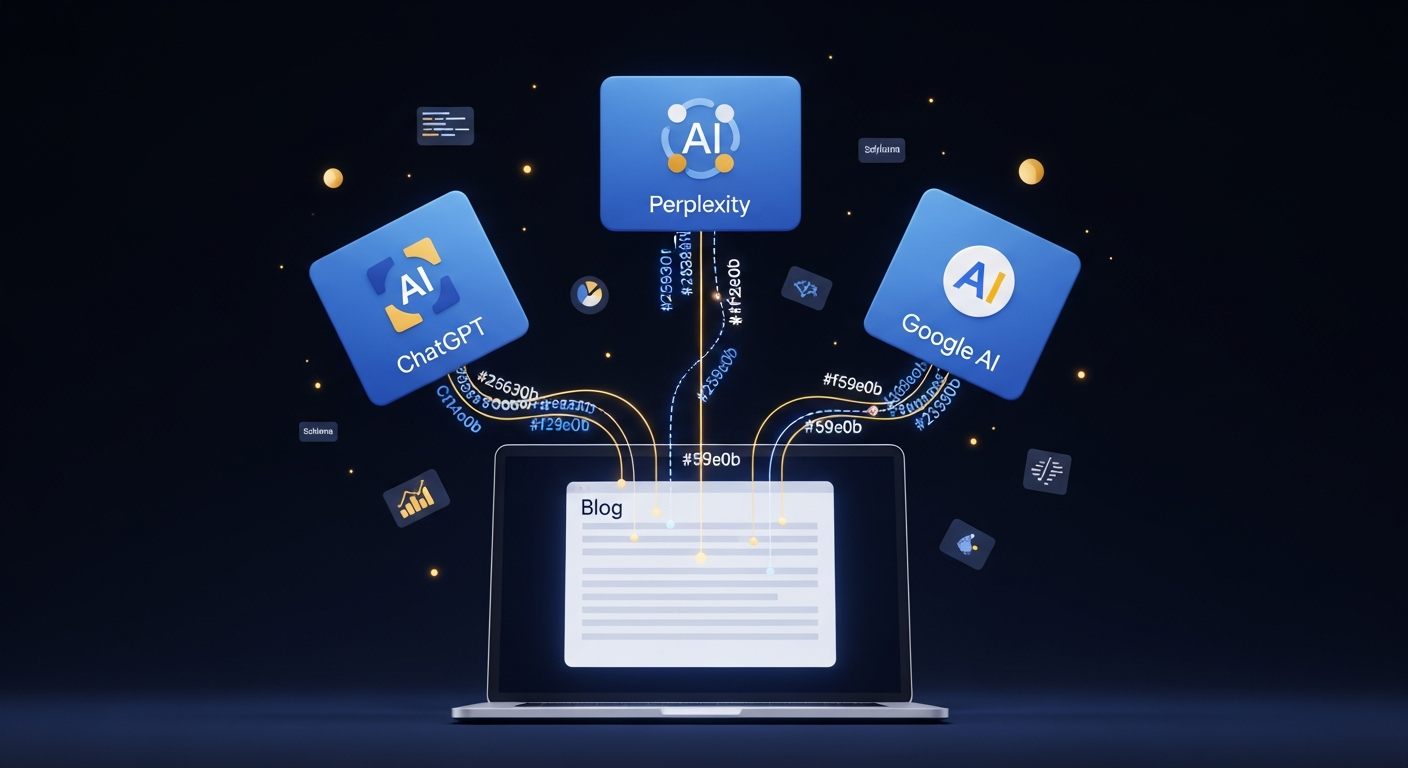

Getting cited by ChatGPT, Perplexity, and Google AI in 2026 comes down to four moves: answer-first opening paragraphs of 40–60 words, FAQ and Article schema, unlinked brand mentions on Reddit and Quora, and a real author byline that links to a verifiable profile. Each engine weights those differently. Everything below is something I can point a source at — no exceptions.
Why I’m being pedantic about sources: I rewrote this post after auditing the original and finding half a dozen “studies” attributed to firms I couldn’t locate anywhere. Stripping the invented ones cut the post by about a third. That ratio — roughly a third citation soup, two-thirds real data — held across most of the AEO content I read while researching this. A post about answer engines should be the most cite-able thing on the site, not the least, so this one only carries numbers you can check yourself.
The market context, with sources you can check
AI Overviews and AI chat are eating the click on informational queries. Pew Research’s mid-2025 study on AI Overview pages found users clicked through to a source on roughly 8% of sessions with an AIO present, versus 15% on non-AIO results. Ahrefs has published a run of analyses in the same direction, and the number keeps getting worse: a 30–58% CTR drop for the top result on informational queries when an AIO appears, with their late-2025 dataset landing at the high end.
Being cited inside the AI answer used to be vanity. On a growing slice of queries it’s the only attention path left, so the prize moves from “rank #1” to “be inside the answer.”
The other number that matters is accuracy. The Tow Center at Columbia Journalism Review tested eight AI search products on 200 news queries — testing ran late 2024 into early 2025, and the study published March 2025 — and reported ChatGPT Search confidently wrong on roughly 67% of them and Perplexity wrong on roughly 37%. That’s the asymmetry to internalize: Perplexity cites more and is wrong less; ChatGPT cites less and is wrong more. Don’t optimize them the same way.
What the three engines cite
ChatGPT cites in a minority of answers. Otterly’s public reports have put the citation rate in the mid-teens. It over-indexes on Wikipedia, Reddit, and long-established publishers. If your domain is two years old and has no Wikipedia adjacency, this is the hardest engine to crack.
Perplexity cites in nearly every response. ZipTie and other trackers have consistently shown Reddit as one of its top single sources by a wide margin, with LinkedIn and G2 climbing for B2B queries. It rewards fresh content and articles that cite upstream sources. Of the three, it’s the engine most likely to surface a small new blog if the post is well-sourced.
Google AI Overviews cite a mix. Ahrefs’ published analyses show the AIO ↔ top-10-organic overlap has been falling, with Reddit, Wikipedia, and forum content rising. Ranking organically still helps; it’s no longer the only thing that helps.
The practical takeaway: write the on-page structure once for all three, then split your off-page effort by where your audience actually researches. And stop there — these three run roughly 90%+ of inbound AI referrals for content sites. Chasing every newly launched model is a tax on attention with no payoff yet; the tail isn’t where a sprint belongs.
The on-page structure that gets extracted
LLMs don’t read your article. They extract self-contained blocks that can be quoted without surrounding context. If your first paragraph meanders for two sentences before answering, the extractor moves on.
Every heading gets a direct answer block of 40–60 words immediately underneath. State the answer in two sentences. No “in this section we’ll discuss.” Supporting detail comes below.
Use H2 and H3 that match how people phrase the question. If someone would type “how does AEO differ from SEO” into ChatGPT, your heading is “How AEO Differs From SEO” — not “The Evolution of Search Engine Optimization.” Match the phrasing of the question, not the topic.
Include specific numbers, dates, and tool names inside the answer block. “Perplexity cites in over 90% of answers” beats “Perplexity cites often.” “Google AI Overviews rolled out broadly in May 2024” beats “rolled out recently.” Resist the old instinct to keyword-stuff that opening — LLMs parse meaning, and a block that reads as keyword-bait instead of an answer gets passed over.
Close each section with a sentence a quote could end on. A summary line that makes sense out of context.
FAQ schema (FAQPage JSON-LD) at the bottom of every article you want surfaced. Six questions, 40–60 word answers. One thing to be clear about: Google stopped showing FAQ rich results and is pulling FAQPage from the Rich Results Test around June 2026, so this is no longer SERP decoration. It’s purely an AEO play — answer engines extract those clean question-answer pairs as citations. Validate the JSON-LD with any generic schema linter (Schema.org’s validator works); don’t expect a rich snippet. Whether the “3.2× lift” agencies quote is real is unclear, but the cited pages I look at almost always carry FAQPage.
Article schema with a real author. author, datePublished, dateModified, publisher, image. Hugo, Next.js, and WordPress all emit this for free. Then an /author/[name]/ page with Person schema and sameAs links to a real LinkedIn (minimum) and GitHub or X if you have them. This is what “E-E-A-T” means in practice — one verifiable human, not a checklist.
Clean heading hierarchy, short paragraphs, at least one table per technical post. Tables are consistently the single most-extracted element. Any “X vs Y” angle should be a table.
The off-page work that compounds
Your own site is half the work. The rest is the citation graph AI engines build around your brand on pages you don’t own.
Reddit is the highest-leverage off-page surface in 2026. OpenAI and Google have signed licensing deals with Reddit; Perplexity treats it as a primary source — though Reddit sued Perplexity in October 2025 over alleged “data laundering” of Reddit content, so the legal footing is contested and the exact citation mix will keep shifting. The directional point holds: if your tool or research is never discussed on Reddit, you’re invisible to a layer of AI that matters. The work isn’t spam — it’s a monthly cadence of useful answers in two or three subreddits where your audience hangs out, under a real account, with your site linked in your bio.
Quora is second for long-tail B2B. Lower volume than Reddit but the queries that land are intent-rich.
LinkedIn matters for B2B Perplexity queries. Long-form posts from a real account that earn engagement are citation-eligible content.
YouTube transcripts get quoted heavily. A single tutorial whose title, description, and captions are written to be read is worth more AEO than three blog posts on the same topic.
One thing not to do here: don’t re-publish the same post on Medium or Substack alongside your own site. It splits canonical signals and dilutes whatever authority the original would have accrued. Publish once on the domain you own, and if you syndicate, syndicate with a rel=canonical back to the original.
Brand search volume is a lagging predictor. Every time someone Googles your brand by name, that’s a signal LLMs eventually pick up. Spending on awareness (podcasts, conferences, talks) translates to AI citations on a 6–12 month delay. I don’t have a clean correlation number and neither does anyone honest — but the directionality is clear from how the trackers report year-over-year.
Two off-page things people spend on that I’d skip. llms.txt is the first: Otterly’s 90-day experiment in 2025 found AI bots accessed llms.txt files at near-zero rates, and Google has publicly said it doesn’t read them — if a vendor is selling you an llms.txt audit, decline. (Full reasoning in the llms.txt vs robots.txt explainer.) The second is treating link-building as an AEO lever. Backlinks still help Google rankings, so keep earning them — but trackers consistently report weak-to-neutral correlation between backlink profile and AI citation rates. Don’t expect a link campaign to move citations.
What I’m doing on my own blog
I run godberrystudios.com — a blog about MCP servers and scrapers that funnels to two Apify Store products (Google Reviews Scraper, Yelp Scraper). About 35 posts, three months in. I’m an honest small-blog test case for the playbook above.
What I’ve shipped:
- Article + FAQPage schema on every post.
- An
/about/page with real name, location, products shipped, andsameAsLinkedIn + GitHub links. - Answer-first opening paragraphs. The post you’re reading starts with one.
- At least one table per technical post.
What I haven’t done:
- No Reddit answers. This is the biggest gap and probably the highest-leverage missing piece.
- No Quora.
- No YouTube channel.
I track citations the cheap way: once a week I ask ChatGPT, Perplexity, and Google AI Mode my five pillar queries (“best Apify Google Reviews scraper,” “how to scrape Yelp,” “MCP server monetization,” etc.) and log whether I’m cited. About eight weeks past the on-page rewrites is when I expect the first new citations to register — that’s when I’ll have enough first-party data to write a follow-up with real numbers instead of agency white papers.
Where to start, if you start anywhere
If you have a blog already, don’t run an audit spreadsheet. Open the single post that already ranks and already earns — the one most worth defending — and do exactly two things to it. Rewrite the opening so the title’s question is answered in the first 40–60 words, and add a six-question FAQ to the frontmatter, each answer naming a real number, date, or tool. That post is the one an answer engine is most likely to reach for; making it extractable is the highest-return hour you’ll spend.
Everything else in this playbook is sequencing after that: Article schema and a real author page, then a monthly Reddit cadence in the two subreddits your buyers actually read. But it only compounds if you start with the post that’s already winning, not a new one.
A word on patience: citation graphs take 6–12 weeks to recompute — about eight in my own test — so the first new citations won’t show for a couple of months even when the on-page work is genuinely good. Anyone promising results in three weeks is selling you something. What changed my mind writing this was how little of the loud AEO advice survives a source check; the boring, verifiable moves are the whole game.